How to read the stamps on jewelry: 925, 585, 750, and the rest of the code

A stamp is the smallest and most honest sentence on any piece of jewelry. Photography can flatter a chain, a listing can overstate it, but a stamped “585” inside a ring is a specific, checkable claim: 58.5 percent of the metal in that ring is pure gold. Reading stamps turns jewelry buying from vibes into arithmetic, and it takes about ten minutes to learn the whole code.
This page covers the numbers, the letters, the official hallmark systems, and where to look for all of it on a physical piece.
The fineness numbers: what the digits mean
Two notation systems describe the same fact. Karat notation, standard in the United States, expresses purity in 24ths: 24k is pure gold, 18k is 18 parts gold of 24, and so on down to the 10k that US trade convention treats as the practical floor for anything sold as karat gold. Millesimal notation, standard across most of Europe and required on officially hallmarked goods there, expresses the same thing per thousand: 750 is 75 percent pure, 585 is 58.5 percent, 417 is 41.7 percent, and 375 is 37.5 percent.
A piece might carry either or both — imported goods stamped “750” in Europe often arrive in the US marked “18K” as well. The translation is the useful skill: 999 is pure (fine) gold, 916 is 22k, 750 is 18k, 585 is 14k, 417 is 10k, and 375 is 9k. Higher numbers mean more pure gold, which means softer metal, warmer color, and higher metal value per gram.
Karat marks versus millesimal marks
The two systems differ in more than format. Karat marks carry no legal verification in the United States — a manufacturer stamps 14k and stands behind it under Federal Trade Commission jewelry guides, which require accuracy in metal marking but involve no assay office testing the piece. Millesimal marks in hallmarked goods, by contrast, are applied by an independent assay office after testing, which is the subject of the hallmark section below. In practice: a US karat stamp is the maker’s word; a European hallmark is a tester’s word.
The letters: GF, GP, GE, and HGE
Letters next to a number change the meaning entirely.
Gold-filled: read the fraction
“GF” means gold-filled: a solid sheet of gold mechanically bonded to a base core, with the fraction stating its weight share. “1/20 14K GF” is the full honest sentence — a 14k gold layer making up one-twentieth of the piece’s weight, which is the long-standing trade standard for the term. Gold-filled wears for years, because its layer is orders of magnitude thicker than plating. A gold-filled stamp with no fraction (“GF” alone) is half a sentence, and the missing half is the part that makes the term meaningful.
The plated abbreviations
“GP” (gold plated), “GE” (gold electroplate), and “HGE” (heavy gold electroplate) all describe electroplating: gold deposited from a chemical bath in microns. “Heavy” in HGE signals a thicker deposit than standard electroplate, but still a plated piece with no weight fraction. None of these constructions is stamped with a bare karat number — a bare “14K” implies solid gold. And phrases like “gold-tone” or “gold-dipped” are not standardized at all; they appear on stamps less often than on listings, and they never mean solid.
Silver stamps beyond 925
Silver runs its own number line. “925” is sterling — 92.5 percent silver — and it is the mark you will see on nearly all quality silver jewelry, usually on a clasp tag, the inside of a ring, or a post. “999” or “999 Fine” marks pure silver, used mostly in bullion products. “958” is Britannia silver, a British standard. Older continental pieces may carry “800” or “835,” lower-silver standards legal in parts of Europe. “Coin silver” (900) appears on American antiques.
Vermeil deserves one line here: by United States Federal Trade Commission guides, “vermeil” requires a sterling silver base coated with gold at least 2.5 microns thick, so a vermeil piece is stamped 925 for its base — the stamp tells you the base metal, and the word vermeil should be telling you the rest.
Hallmarks: the assay office system
A hallmark is a stamp applied by an independent testing body, not the maker. The United Kingdom runs the most structured version: an item of precious metal above specified weights is tested at an assay office, and the hallmark typically records the fineness number, the office’s own symbol — the leopard’s head for London, the anchor for Birmingham, the crown for Sheffield, the castle for Edinburgh — and often the year letter and maker’s mark. A full UK hallmark is therefore a small paragraph: who made it, what it is made of, where and when it was tested.
Other countries run lighter systems. France uses its own eagle-head mark for 18k, Italy historically stamped makers’ numbers, and many exporting countries rely on millesimal marks without assay verification. The useful takeaway for a buyer is the distinction from the previous section: a hallmark is third-party tested, a karat stamp is first-party claimed, and when the two appear together on an imported piece, the hallmark is the stronger of the two.
Where to find the stamp on each piece
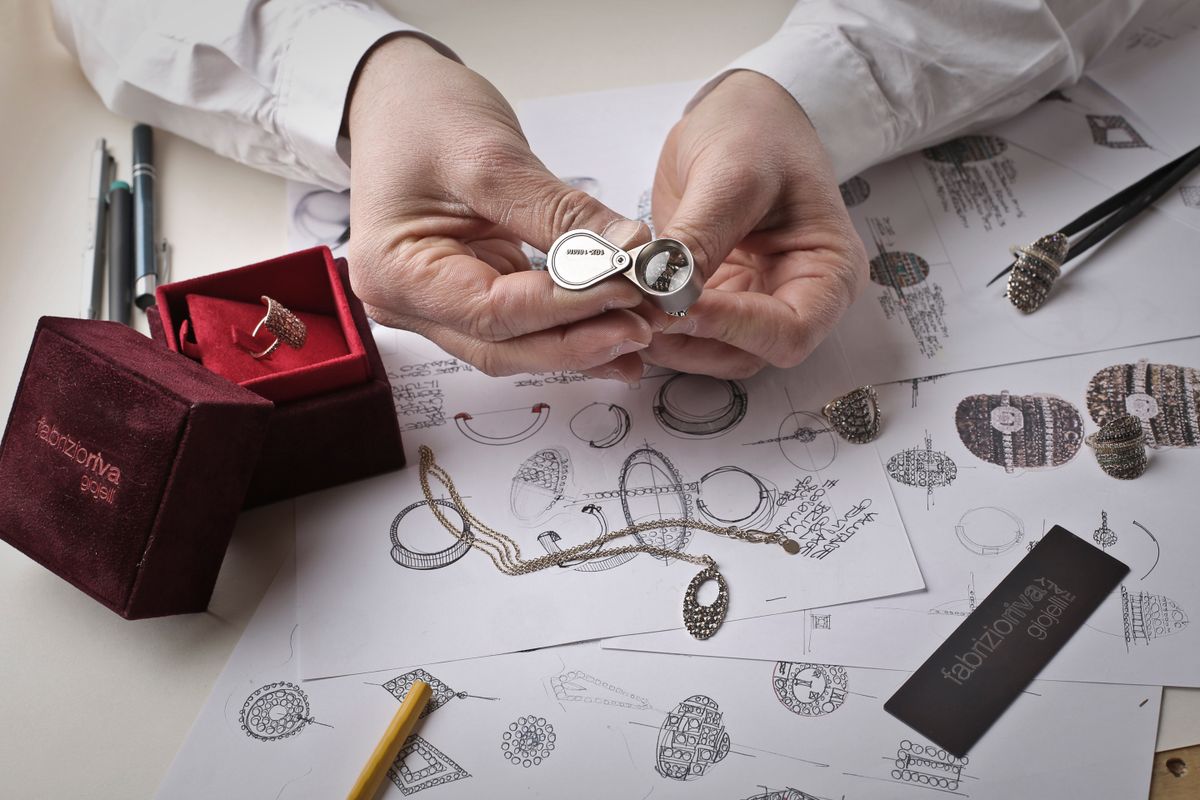
The stamp hides in the same few places on every category. Chains: on the tiny rectangular tag just above the clasp, occasionally on the clasp itself. Rings: on the inside of the band, sometimes obscured by resizing work. Earrings: on the post or the butterfly back; studs often stamp only the post. Bracelets: on the end link or clasp plate. Charms: on the top ring or bail. A 10x jeweler’s loupe — a few dollars, sold everywhere — turns the hunt from squinting into reading, and it earns its price the first time you verify a clasp stamp at a market stall.
When there is no stamp
Missing stamps have innocent explanations: the piece is too small or thin to stamp (tiny charms, huggie hoops), it was resized or repaired and the stamp area was cut away, it predates mandatory marking, or its country of origin does not require one. So absence alone is not evidence of fakery. What absence does change is the burden of proof: a stamped “750” is a checkable claim, while an unstated metal is a seller’s prose. If a listing or seller describes a piece as solid gold or sterling but the physical piece arrives unstamped, ask directly — reputable sellers will confirm the metal in writing, and a hedged answer is an answer.
The reference table
| Stamp | Meaning | Construction |
|---|---|---|
| 999 | 99.9% pure gold or silver | Bullion-grade solid |
| 916 | 22k gold (91.6%) | Solid gold |
| 750 | 18k gold (75%) | Solid gold |
| 585 | 14k gold (58.5%) | Solid gold |
| 417 | 10k gold (41.7%) | Solid gold |
| 925 | Sterling silver (92.5%) | Solid silver, or vermeil base |
| 1/20 14K GF | 14k layer at one-twentieth of weight | Gold-filled |
| GP / GE / HGE | Plated, electroplate, heavy electroplate | Coated, thin gold layer |
Three habits close the loop. Read the stamp before reading the price, because the stamp prices the metal. Cross-check the stamp against the listing’s claim — a “solid 18k” listing whose clasp tag reads “GE” is a misrepresentation worth returning inside the window. And treat the stamp as the start of verification rather than the end: our vermeil and plating guide explains the constructions the letters hide, and the standards we apply when checking a piece are laid out on the appraisal methodology page.
Frequently asked
What do 585 and 750 mean on gold jewelry?
They are millesimal fineness marks: the number of parts pure gold per thousand. 585 means 58.5 percent pure gold, which corresponds to 14 karat, and 750 means 75 percent pure gold, which corresponds to 18 karat. The same system gives 417 for 10k and 375 for 9k.
What does GF 1/20 mean on a bracelet?
It is the gold-filled fraction: the piece carries a mechanically bonded gold layer accounting for one-twentieth of the item's total weight, and the karat after the fraction names that layer. So a stamp reading 1/20 14K GF means the outer layer is 14k gold at the one-twentieth weight standard — many times thicker than electroplating.
Is a missing stamp proof that jewelry is fake?
No. Small charms, thin bands, and pieces resized or repaired sometimes lose their stamp, and some countries do not require one. A missing stamp on a piece sold as solid precious metal is worth a question to the seller, but the stamp's presence is the stronger evidence, not its absence.