Jewelry that survives knits: chain choices and the order you dress
Every winter produces the same small tragedy: a fine sweater with a pulled thread and a chain that did nothing obviously wrong. The snag was not bad luck. Knits and jewelry interact mechanically — a knit is a grid of loops, and any jewelry element with a projecting point or an open link acts as a hook under friction. The good news is that the interaction is predictable, which means it can be designed around. Chain profile, dressing order, and a few garment-specific habits cover almost the entire problem.
Why knits snag: the loop does the damage
A knit is built from interlocking loops of yarn, and a snag happens when one of those loops is caught and pulled until it telescopes out of the fabric. The visible damage is a loop standing proud of the surface; the underlying shift is that loop’s yarn length moving from its neighbors into the pulled section. Nothing needs to break for a snag to happen — which is also why a snagged sweater is usually repairable, and why pulling harder only makes it worse.
The jewelry side of the equation is contact repeated lightly. A rough link does not tear through wool on the first pass; it hooks a loop on the tenth or the hundredth. That is why the pieces that cause trouble are worn close to knit contact zones — necklines, cuffs, the back of a collar under a coat — and why the fix starts with choosing profiles that present nothing to hook.
Chain profiles, ranked by snag risk
Not all chains interact with fabric the same way. The difference is profile: whether the chain presents a continuous smooth surface or a series of edges, gaps, and points.
The closed, smooth profiles that coexist with wool
Snake chains, omega chains, and tightly closed box chains present a continuous or near-continuous surface — there is no gap for a yarn loop to wander into and no point to hook. These are the workhorses of knit season, and they also happen to sit flat against the body, which reduces the friction contact in the first place. A smooth pendant with no prongs or protruding bails extends the same logic to the front of the stack; a bezel-set stone is a knit-season stone, while prong heads are hooks waiting for contact.
The open-work styles to save for smooth fabrics
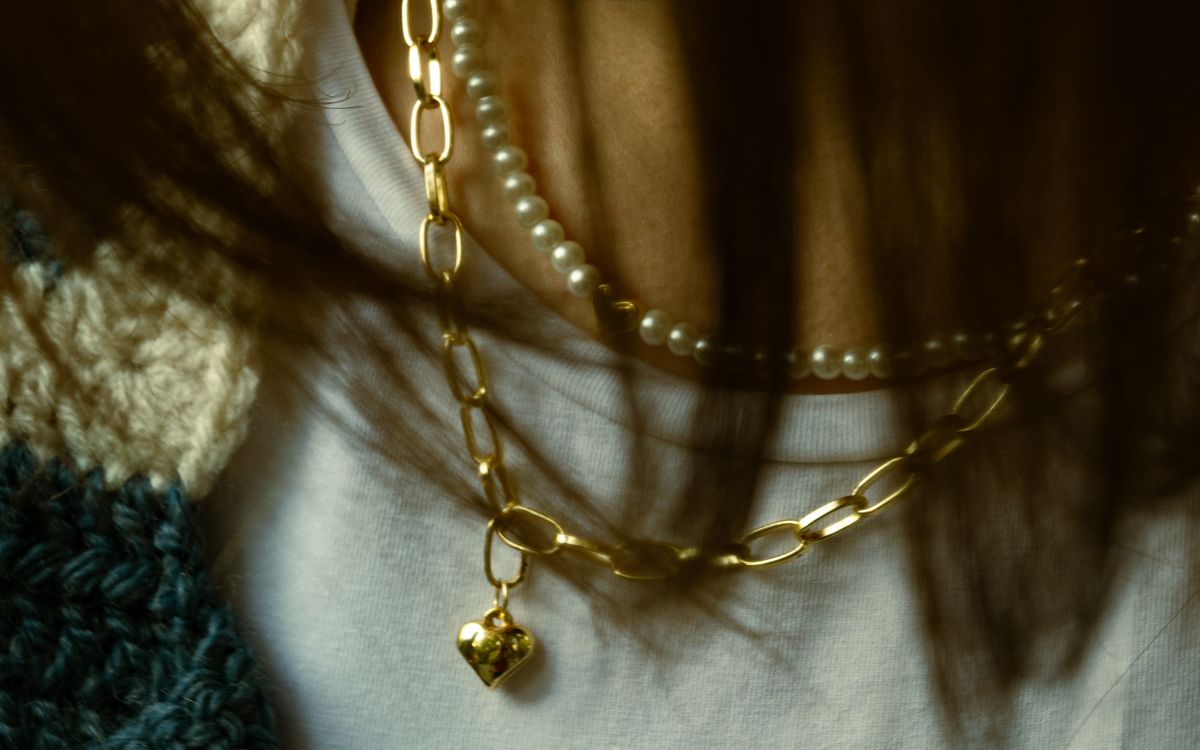
At the other end sit the chains that earn their character from open space: paperclip links with large rectangular gaps, curb links with loose solder, rope twists with projecting points, and anything charm-laden. As a working rule rather than a law of physics, these pieces behave beautifully on bare skin and smooth weaves and become liability against loops. The distinction is not that they are worse chains — several are sturdier constructions than their closed rivals — but that their geometry and wool’s geometry interact badly. Save them for the days the outfit is smooth.
The dressing order is half the fix
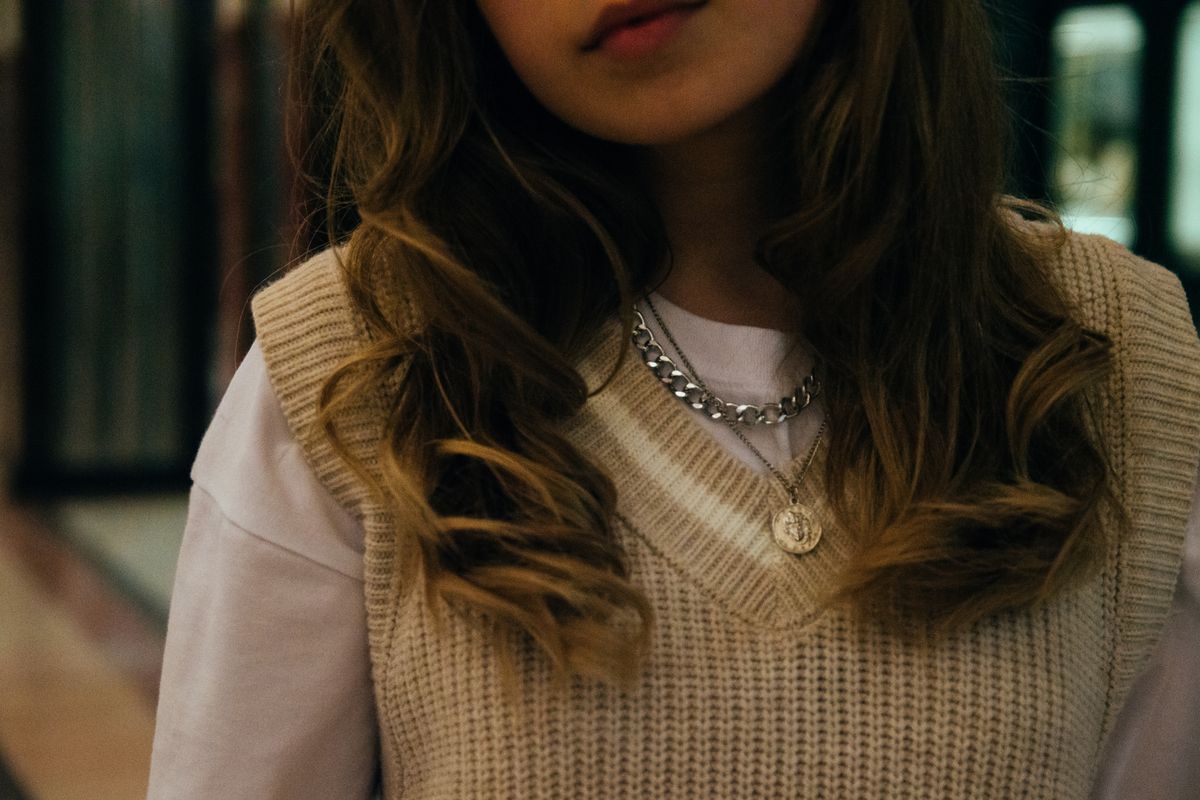
The chain can be perfect and the outfit can still fail if the order is wrong. Jewelry goes on after the knit and comes off before it. The dangerous move is pulling a sweater over the head while wearing a necklace: the chain rides across the entire surface of the fabric, pressing into every loop on the way down, and a single pass can drag a link through the placket zone. The same applies in reverse — removing a knit over a necklace repeats the whole journey upward.
The take-off order matters more than the put-on order
Putting on is a controlled motion; taking off, at the end of a long day, is not. The end-of-day sequence that avoids most accidents: unfasten the necklace at the back or side while the knit is still on, lift the chain away from the body, then remove the sweater. Earrings come out before the sweater crosses the collar, because a drop earring catches on the neckline with impressive reliability. Rings come off before gloves and pockets enter the story, for the same reason. None of this takes longer than a minute, and it covers most of the year’s snags on its own.
Sleeves, cuffs, and the wrist problem
The wrist sits in a contact zone all day: sleeve cuffs slide over it every time an arm moves, and cuff friction against a bracelet is the standard mechanism behind both snagged knits and scratched links. Slim, closed-profile bracelets — a tennis line is the classic example, and the tennis bracelet guide covers why its continuous construction behaves well — sit lower under a cuff than a bangle and present fewer edges. Wide bangles and charm bracelets belong to the same category as open-work chains: excellent against smooth fabrics, risky under sweater sleeves.
Watches get a note of their own because they are worn daily regardless of outfit: a metal bracelet on a knit-sleeve day lives in permanent cuff friction. If the sleeve is wool, positioning the watch so the cuff clears it, or choosing a leather strap for the season, reduces a full day of rubbing to none.
Rings and knits: the small-size drift
Cold weather brings a detail that surprises people every year: fingers measure slightly smaller in the cold, and a ring fitted in summer can feel loose under winter conditions. A loose ring is a snag risk twice over — it rotates more against knit cuffs, and a prong or channel edge moving freely across wool collects loops the way a fixed ring does not. If a favorite ring starts spinning freely every winter, it is worth a professional fit check rather than a seasonal tolerance; the ring size guide explains how sizing varies with temperature and time of day.
When a snag happens anyway
Even a disciplined system loses occasionally, and the first sixty seconds decide whether the sweater survives. Stop at the first visible loop — do not pull it, do not cut it. Cutting turns a redistributable loop into a hole; pulling breaks the yarn and runs a ladder into the knit. Instead, turn the garment inside out, find where the pulled loop enters the fabric, and work it back through to the reverse side with a blunt needle or a small crochet hook, easing the tension along the loop’s path rather than yanking the loop itself. The loop redistributes its yarn back into the surrounding stitches, and the knit returns to service with no visible trace. The chain gets checked afterward with the same care: a link that bent during the catch is repaired before its next wear, not after it opens. The styling desk keeps the seasonal notes that pair with these repairs, and the garment — like the jewelry — usually comes out of the incident fine when the first response is slow.
Frequently asked
What chain types are least likely to snag on knits?
Closed, continuous profiles: snake, omega, and tightly closed box chains present no loops or points to catch. Loose curb links, open paperclip styles, rope twists with projecting points, and any chain with visible gaps between links all carry snag risk against wool.
Should jewelry go on before or after a sweater?
After, always — and off before the sweater comes off. Pulling a knit over the head drags a chain across the full surface of the fabric. Fasten jewelry once the neckline is in place, and reverse the order at the end of the day.
How do you fix a knit snagged by jewelry?
Do not pull the loop. Stretching it breaks the yarn. Work the pulled loop back to the reverse side with a blunt needle or crochet hook from the inside of the garment, then ease the tension flat. The knit recovers; the loop redistributes.