Stacking rings that stay put: width gradients, spacers, and midi placement
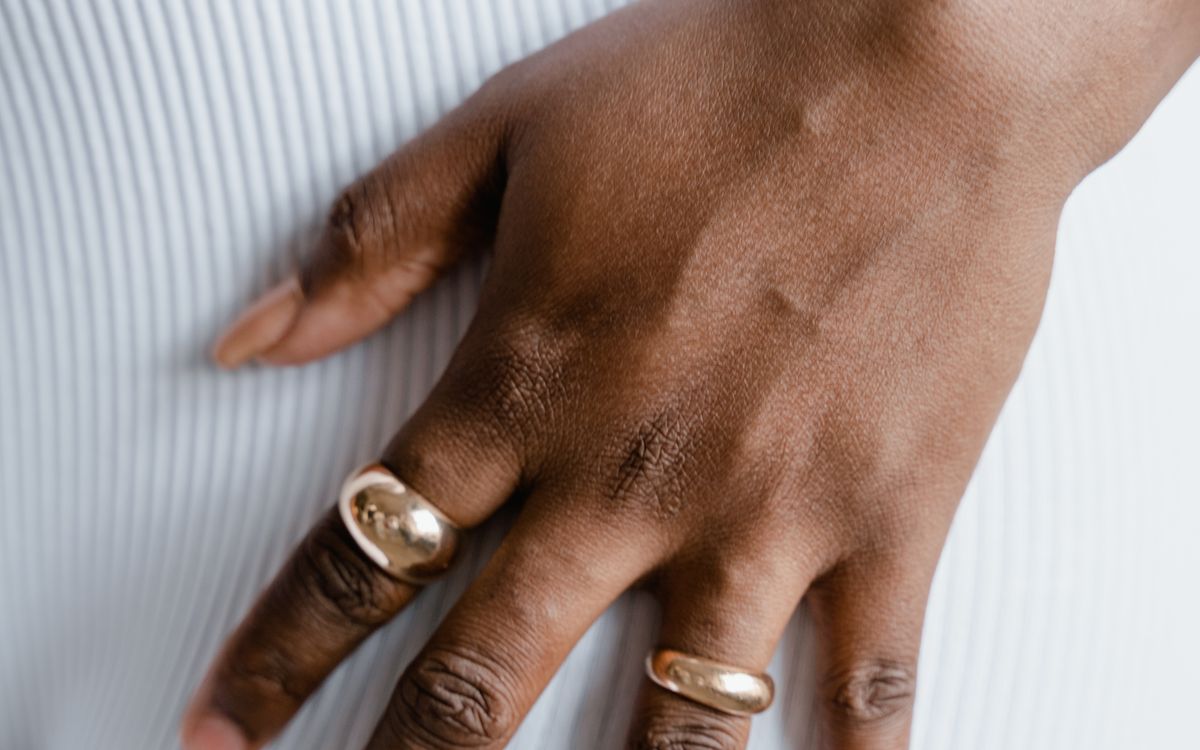
A ring stack is one of the few jewelry looks where the pieces are more or less interchangeable — plain bands, textured bands, the same few shapes — and yet some stacks photograph as a single composed object while others look like a drawer spilled. The difference is never the individual rings. It is width, spacing, and placement, handled as a system.
The width gradient does the structural work
The rule behind most stacks that read as deliberate: vary the width of every adjacent band. Two 1.5 millimeter bands stacked together merge into one confused line; a 1 millimeter band next to a 2.5 millimeter band next to a 1.5 keeps each ring legible. The classic build is a gradient — thinnest at the base of the finger near the palm, thickening toward the knuckle, or the reverse. Either direction works; mixing directions within one finger is what looks accidental.
A stack of four or five bands across a range of widths also wears better through the day than a stack of same-width bands, because the widths lock against each other. Uniform stacks slide as one unit and rotate; gradient stacks stay where they are put.
The one-anchor exception
The exception that works: one wider or textured ring treated as the anchor, with two or three thin bands bracketing it. The anchor gives the eye a place to land and the thin bands give it context. The failure mode is two anchors — two wide rings fighting on the same finger — which is the fastest way to make a stack read as clutter.
Spacers and the case for negative space
A spacer is a plain band, usually under 1 millimeter, whose entire job is separation. Between two textured or engraved rings, a spacer stops the patterns from colliding and gives each design room to be seen. Stacks built entirely of textured rings tend to blur into one noisy surface; adding one plain band between every textured pair restores the rhythm.
The other form of separation is no ring at all. A gap — one band on the base of the finger, one just above the knuckle crease — reads as a stack as long as the two rings relate in width or metal. Contiguous stacks demand width variety; spaced stacks demand instead that the rings feel related. Choose one mode per finger. A finger running a tight contiguous stack below the knuckle plus a lone midi above it is running two systems at once, and it shows.
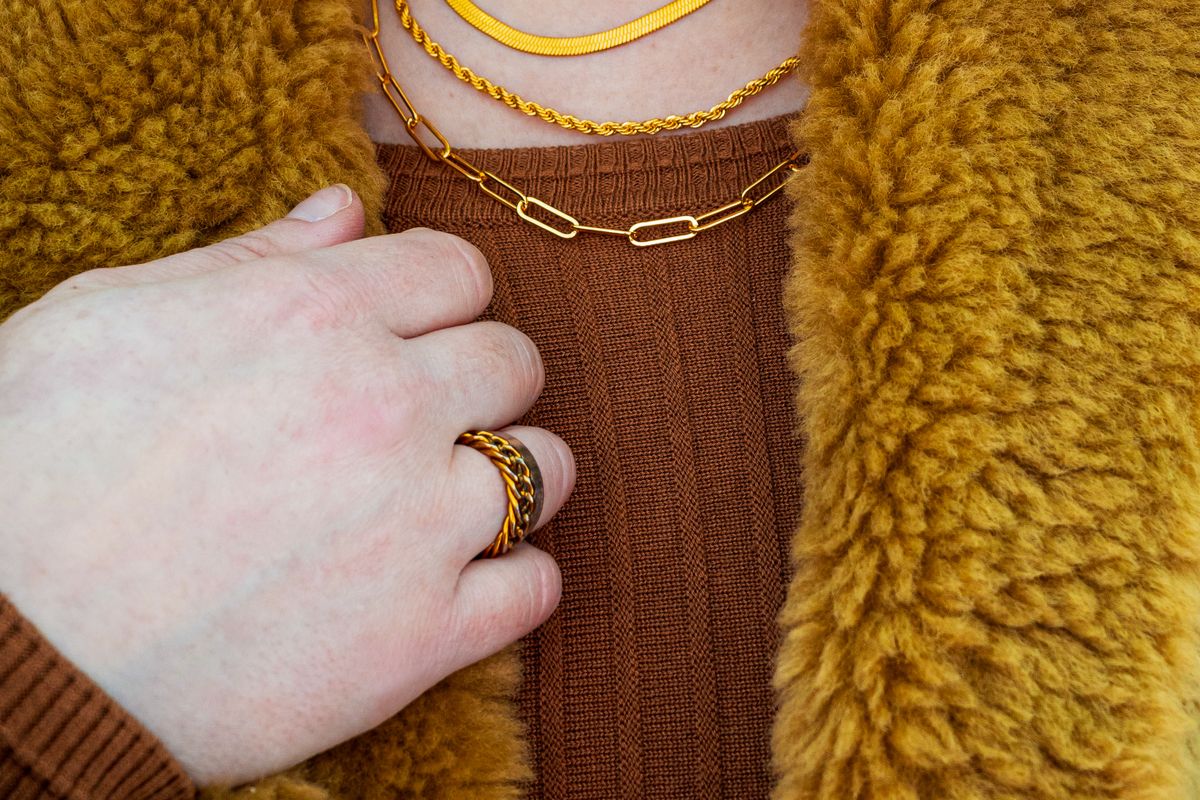
Midi rings sit on a different anatomy
Midi rings are worn above the knuckle crease, on the narrower middle segment of the finger, and everything about their fitting follows from that. The sizing convention is one to three sizes below your standard ring size, but the honest answer is that the knuckle decides: the ring has to pass over the knuckle to go on and then hold position above it. Fingers with prominent knuckles need a larger midi than the finger width suggests; smooth-knuckled fingers can size down harder.
Two or three midi rings per hand is the practical ceiling, and they read best when they echo something from the main stacks — the same metal, the same width family. A stack of five midis turns the hand into a costume.
How many rings before the stack stops working
The per-finger ceiling is around four bands; past that, widths crowd and the stack starts catching on fabric.
Balance across both hands
The per-hand count is the one people skip: three to five rings across a whole hand, midi rings included, keeps the look in daylight territory. Balanced across both hands, a larger total count still reads composed — three on one hand and two on the other beats five on one hand and none on the other, even at the same total.
Hands do most of the communicating in conversation, which is why the per-hand number matters more than any per-finger math. The stack is read in motion, at conversational distance, by people who see it for seconds.
Mixing metals inside one stack
Metal mixing in a stack follows a dominance rule rather than an even split: one metal carries roughly two-thirds of the bands, and the second metal appears as one or two accents. A stack of alternating gold and silver bands splits the eye every time it moves. The dominance structure also future-proofs the stack — new bands join whichever metal is dominant without a reorganization.
Mixed-metal stacks also hide wear better, which matters because stacks are worn hard. For how the common gold-family constructions hold up under that kind of daily friction, the vermeil explainer separates the constructions that suit a hard-working stack from those that suit occasional wear.
Sizing the stack without guesswork
Stack sizing has two quirks beyond standard ring sizing. Wide bands — anything over about 5 millimeters — are commonly sized up a half size, because a wide band grips the full finger length and needs the clearance a narrow band does not. And a stack of three thin bands worn together sits tighter than each band alone: the bands wedge against each other, so some wearers take the stack a quarter size up from their single-band size.
Both quirks point at the same advice: size for the knuckle and for comfort through a full day, not for a snug fit at the counter. The measurements and fit checks that make this reliable are laid out in the ring size guide.
Stacks take more impact than any other ring habit
A stack of four bands is four surfaces rubbing, catching, and taking knocks with every hand motion. Thin bands are the first casualties — a 1 millimeter band thins visibly where it contacts the others, and plated finishes wear through at contact points within a season of hard wear. Rotating two stacks rather than wearing one daily doubles the lifespan of both, and periodic checks for thinning at the contact points catch a failing band before it snaps.
When a band does fail, the break location usually explains the cause — a crack at the contact point means friction wear, a clean snap at the shank means a catch and a pull. The repair and assessment logic lives in the metals guides.
Frequently asked
How many rings can you stack on one finger?
Two to four on a finger, three to five on a hand. Past four on a single finger the band widths crowd each other and the stack stops reading as a stack. The per-hand count matters as much as the per-finger count.
What size should midi rings be?
Usually one to three sizes below your standard ring size, because they sit above the knuckle where the finger narrows. The knuckle itself decides the real number — the ring must pass it to go on, then hold position above it.
Can you mix metals in a ring stack?
Yes, but one metal should dominate the stack, with the second metal appearing as one or two deliberate accents. A stack split evenly between two metals reads as indecision rather than a mix.