Three silk scarves, compared on momme, weave, and hem
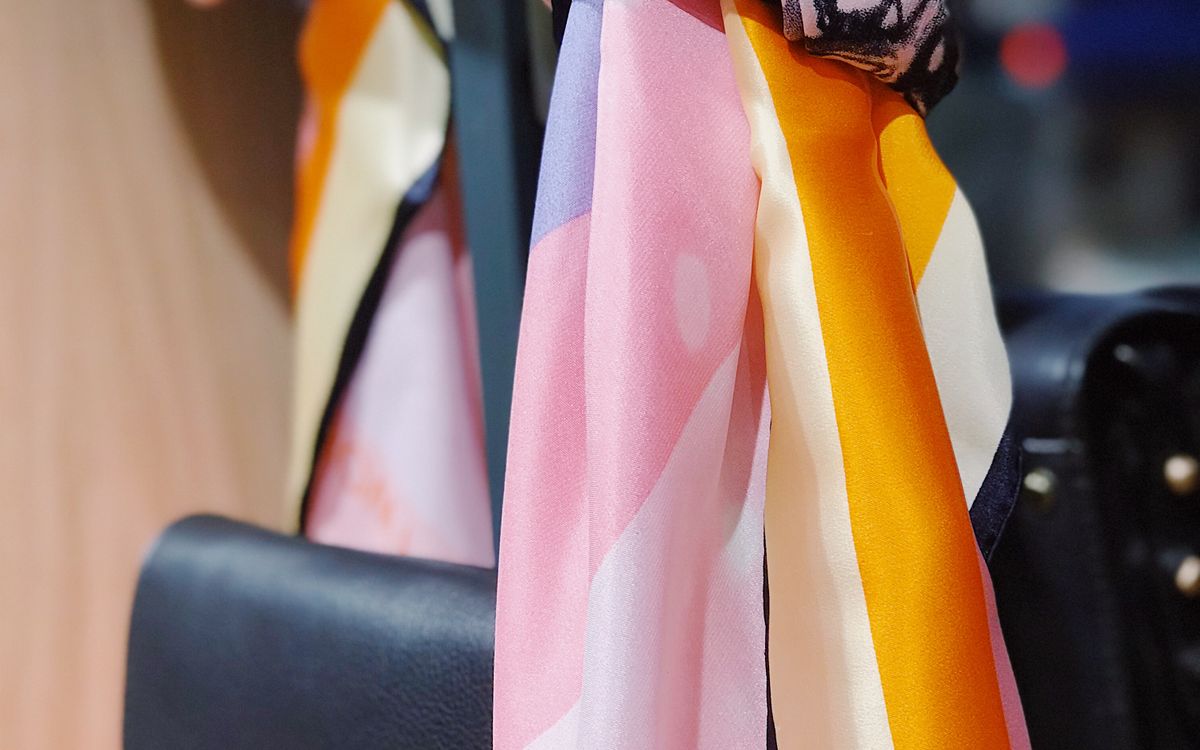
Two scarves can both be labeled 100 percent silk and behave nothing alike. One drapes with weight and keeps a pressed edge; one skims the collar like a whisper and curls at the corners by the second wear. The differences that explain that gap are all published somewhere — in the momme number, in the weave named on the material line, in whether the hem is rolled by hand or by machine — but most scarf listings publish only some of them, and the buyer’s job is to compare what is stated against what matters.
The three scarves below were chosen because each states different parts of the story in plain language. One is a limited-edition silk twill square with a hand-rolled hem from a heritage American scarf house. One publishes its momme weight on the product name itself. One is a certified, lightweight square that costs less than a bottle of conditioner and carries more certification paperwork than either of the others. Together they map the whole trade.
What momme actually measures
Momme (pronounced, roughly, “mom-ee”) is the silk industry’s weight measure: one momme is conventionally the weight in pounds of a piece of silk 45 inches wide and 100 yards long. A higher momme means a denser, heavier weave — more silk in the same area. Bedding typically runs 19 to 22 momme; scarves run lighter, commonly between 12 and 19, because a scarf knotted at the neck or tied to a bag wants drape more than mass. A 14-momme scarf is not a lesser product than a 22-momme pillowcase; it is a different tool, the way a voile shirt is not a lesser denim jacket.
The useful discipline is not chasing the highest number but noticing who publishes one. Momme is measurable, and a maker confident in their silk states it. When a listing says only pure silk at a premium price, the weight is the first question to send. At the value tier, silence is more forgivable — the price already tells you the silk is light — but at the luxury tier, an unstated momme is the category’s most common dodge.
The picks
All three picks below were checked against the makers’ own product pages in November 2026. Prices move, and silk listings rotate seasonally, so treat the numbers as a snapshot.
Echo The Menagerie 35” Silk Square Scarf — the craft pick
Echo is a New York scarf house whose archive reaches back to the 1920s, and the Menagerie square is from its limited-edition Series Collection: 35 inches square, made from silk twill, finished with a hand-rolled hem, and priced at $159 on the maker’s own site with free returns for full-price merchandise. The product page is specific where scarf pages usually blur — the twill weave is named, the hand-rolled hem is stated twice, the size is exact, and the care line says dry clean. A hand-rolled hem is the detail that separates collector-grade squares from the rest: the edge rolls and stitches evenly, the border never curls, and the scarf ties with the crisp corners the great carré tradition is built on.
The trade-offs are care and weight disclosure. Dry-clean-only is a real cost over years of ownership, and Echo names the weave but not the momme of this scarf — the maker’s own copy for a sister piece in the collection describes the same twill as 14-momme, which is a useful frame but not a stated spec for this one. What the $159 buys is the finishing: a hand-rolled, printed silk square from a house that has been making them for nearly a century, sized for everything from a neck knot to a bag tie.
LilySilk 14 Momme Polka Dot Square Silk Scarf — the spec pick
LilySilk puts the number in the product name — 14 Momme Polka Dot Square Silk Scarf, $39.99 on the maker’s US site — and that single act of publication is why it earns a pick. Fourteen momme is squarely in the classic scarf range: light enough to knot twice, dense enough to hold a shape. The brand states across its site that most of its silk products are OEKO-TEX Standard 100 certified, tested for a long list of harmful substances, and its US site lists a 45-day return window at last check.
The trade-offs are the hem and the weave detail. The polka dot square’s page does not state the weave — it behaves like a charmeuse in the hand, glossy and fluid — and neither a hand-rolled hem nor any hem detail is claimed, which at this price is an honest omission rather than a dodge. What you get is the only scarf of the three that tells you exactly how much silk you are buying, at a price where a buyer can afford to own two.
SilkSilky Pure Silk Printed Designer Square Scarf — the value pick
At $19.95 as listed on the maker’s site at last check, the SilkSilky printed square in 53-by-53 centimeters is the certification standout: the product page states the fabric as 100 percent mulberry silk, certified under both OEKO-TEX Standard 100 and GOTS, with a 365-day return guarantee and a rating shown on the page of 121 reviews, 86 percent of them five-star. The page names the weave as charmeuse and is candid about the construction being its ultra-light SilkLight line — smooth, low-friction, quick-drying, and pitched at travel use.
The trade-off is substance: this is the thinnest silk of the three by a visible margin, the momme is not stated, and the hem is machine-finished. It also costs a tenth of the craft pick, ships light in a suitcase, and carries the strongest certification and returns paperwork of the bunch. As a scarf that lives in a bag and ties around a ponytail, a tote handle, or a wrist, it does its job at a price that asks nothing.
Twill versus charmeuse
The weave decides how a scarf takes light and takes wear. Silk twill is woven with a diagonal structure that gives the fabric body and a soft, matte-leaning sheen — it is the classic print scarf weave because it holds a press, resists snags better than a flat weave, and drapes with enough weight to hang straight. Charmeuse is a satin weave, glossy on the face and dull on the back, fluid and light; it slides through knots and reads luminous but shows snags sooner. Neither is better. Twill is the square that knots at the neck and behaves; charmeuse is the scarf that pools and shines. The Echo and the SilkSilky sit at opposite ends of that choice, which is exactly why they compare cleanly.
Reading the hem
The hem is the category’s most legible craft signal. A hand-rolled hem takes trained labor — the edge is rolled between fingers and stitched through the roll itself — and it survives years of knots without curling. A machine-rolled or machine-stitched hem is flat, slightly stiff, and perfectly uniform, which sounds like praise until you hold the two side by side. The Echo’s hand-rolled edge is its core claim; the LilySilk and SilkSilky make no hem claim at all, and at their prices the omission is legible in the listing, not hidden behind one.
Certifications, and what they do not promise
OEKO-TEX Standard 100 is a test of the finished textile for harmful substances — dyes, residues, a long enumerated list — and it is the certification that matters most for something worn against the neck all day. GOTS, the Global Organic Textile Standard, covers the organic and environmental side of production. Neither is a quality grade: a certified scarf can be thin, and an uncertified scarf can be superb silk from a small mill that skipped the paperwork. The SilkSilky carries both certificates at the lowest price of the three; the Echo states neither on the product page. Read certifications as safety disclosures, momme as a construction disclosure, and the hem as the craft disclosure — no single line replaces the others.
Size, and what it lets you do
The 35-inch square is the classic carré proportion — big enough for a shoulder drape or a proper neck knot with volume, small enough to tie to a bag without bulk. The 53-by-53-centimeter SilkSilky is a neckerchief and hair-tie size; it will not drape a shoulder and was never meant to. The LilySilk square sits near the middle. Choose size by the job: if the scarf’s main life is knots at the neck and bag handles, the small square is the honest tool, and the big square is the one that earns its price in winter under a coat collar. Our notes on layering at the neckline cover the same proportion logic at the jewelry level.
Care labels as a quality signal
The care line on a silk product page is information about construction, not just chores. Dry clean only, as on the Echo, usually follows from dense twill and hand-finished edges that a wash cycle would stress. Hand wash cold, as both the LilySilk and SilkSilky instruct, suits lighter charmeuse and printed squares. Neither line means the silk is fragile — mulberry silk is among the strongest natural fibers when wet care is done gently. The practical reading: buy the care routine you will actually keep. A scarf you must carry to the cleaner gets worn less than one you can wash in a basin, and that is a legitimate part of the price comparison. Our full accessories hub includes a dedicated guide to washing and storing silk.
How these three were checked
Every material claim above comes from the maker’s own product page, checked in November 2026: the Echo page for the twill weave, hand-rolled hem, size, care line, and return terms; the LilySilk US site for the momme in the product name, the OEKO-TEX statement, and the return window; the SilkSilky page for the fiber, dual certification, size, care line, rating, and the 365-day return guarantee. Where a spec was not published — Echo’s momme for this scarf, SilkSilky’s momme, both makers’ hem construction beyond the Echo — it is recorded as not stated rather than estimated. For the method behind that rule, see How We Appraise, and for how picks like these translate into gifting, our jewelry gifts guide applies the same evidence-first logic.
The picks
Some links below are affiliate links — we may earn a commission at no extra cost to you.
Echo The Menagerie 35" Silk Square Scarf
$159A limited-edition 35-inch silk twill square from a heritage New York scarf house, finished with a hand-rolled hem, with exact size and care lines stated on the product page and free returns for full-price merchandise.
LilySilk 14 Momme Polka Dot Square Silk Scarf
$39.99The only scarf of the three that publishes its momme weight — 14, squarely in the classic scarf range — in the product name itself, with the brand stating most of its silk is OEKO-TEX Standard 100 certified.
SilkSilky Pure Silk Printed Designer Square Scarf 53x53 cm
$19.95100 percent mulberry silk certified under both OEKO-TEX Standard 100 and GOTS, with a 365-day return guarantee and 121 reviews shown on the maker's page, 86 percent of them five-star. The thinnest silk of the three and the clearest paperwork.
Side by side
| Specification | Echo | LilySilk | SilkSilky |
|---|---|---|---|
| Fabric as stated | Silk twill | Silk (weave not stated) | Mulberry silk charmeuse |
| Momme | Not stated | 14 | Not stated |
| Size | 35 x 35 in | Square; dimensions not stated | 53 x 53 cm |
| Hem | Hand-rolled | Not stated | Not stated |
| Certification | Not stated on product page | OEKO-TEX Standard 100 (brand statement, most silk products) | OEKO-TEX Standard 100 and GOTS (product page) |
| Care as stated | Dry clean | Hand wash | Hand wash cold, shade dry |
| Returns | Free returns for full-price merchandise | 45-day window per US site at last check | 365-day guarantee |
| Price at last check | $159 | $39.99 | $19.95 |
Sources
- Echo New York product page — The Menagerie 35" Silk Square Scarf (echonewyork.com), checked November 2026
- LilySilk US site — 14 Momme Polka Dot Square Silk Scarf listing and OEKO-TEX statement (lilysilk.com), checked November 2026
- SilkSilky product page — Pure Silk Printed Designer Square Scarf 53x53 cm (silksilky.com), checked November 2026
Frequently asked
What momme weight should a silk scarf be?
Most silk scarves sit between 12 and 19 momme — lighter than the 22-momme silk used for pillowcases, because a scarf is worn, knotted, and draped rather than slept on. A maker who publishes the momme number at all is already ahead of the category, where many listings omit it.
Is a hand-rolled hem worth paying for?
It is the single clearest craft marker in the category. Rolling and stitching a hem by hand takes trained labor and shows in the drape of the edge, and makers reserve it for their better lines. It is not the only quality signal — weave and dye matter too — but a machined edge on a premium-priced scarf is a fair reason to ask questions.
Do certifications like OEKO-TEX matter for a scarf?
OEKO-TEX Standard 100 tests the finished fabric for a long list of harmful substances, which matters for a textile worn against the neck and hair. It says nothing about silk grade or durability — it is a safety signal, not a quality ranking, and it should be read alongside momme and weave, not instead of them.